The mother of all bombs would barely scratch Pickaxe Mountain
America's biggest conventional bomb is wide, not deep. Against Iran's most deeply buried site, nothing short of a nuclear weapon reaches the halls
For 'tis the sport to have the enginer
William Shakespeare, Hamlet, Act 3, Scene 4
Hoist with his own petard; and 't shall go hard
But I will delve one yard below their mines
And blow them at the moon.
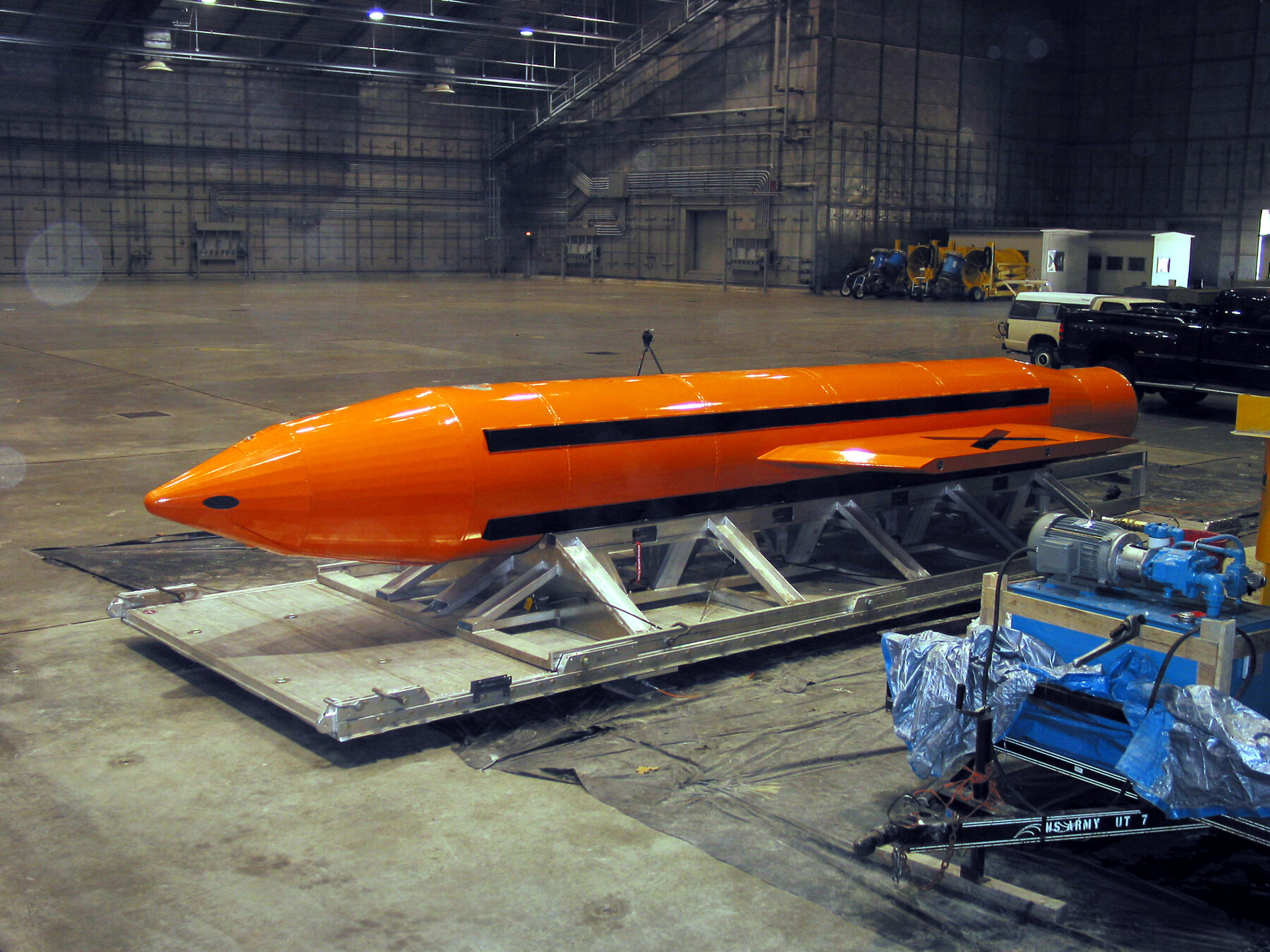
The GBU-43/B is the largest conventional bomb in America's arsenal. Officially the Massive Ordnance Air Blast, it is better known as the "mother of all bombs", or MOAB. It is nine metres long, weighs nearly ten tonnes and carries eight and a half tonnes of explosive. It has been dropped in war once, on a cave and tunnel complex held by Islamic State in eastern Afghanistan in April 2017.
On 15 October CNN reported that American plans to strike Iran's energy and nuclear sites, should President Donald Trump order the fighting to resume, include the MOAB, and that plans for Pickaxe Mountain, a tunnel complex being dug into granite near Natanz, call for it. Officials told the network they doubted the bomb could reach deeply buried facilities. We checked whether they are right.
We built a model from published engineering methods: how far a blast travels through the air, how deep a bomb digs before it goes off, and how hard it then shakes the rock around it. We applied it to the MOAB, to America's purpose-built bunker buster, the GBU-57 Massive Ordnance Penetrator (MOP), and, for comparison, to the B61-12 nuclear bomb at two of its settings.
Wide, not deep
The MOAB is fuzed to go off just above the ground, so almost all its force goes into the air. There it is formidable. Our model puts the overpressure that flattens most buildings out to about 125 metres from the burst, and broken windows out to about 370 metres.
Below ground it does little. Rock reflects most of a blast that arrives from the air. In granite the MOAB's shock is strong enough to wreck a reinforced tunnel only about two metres down. In dense soil it manages about six.
The MOP works the other way. It is a long, narrow, heavy steel case that digs in before it explodes, so its charge, less than a third of the MOAB's, goes into the ground rather than the air. Our model has it dig four or five metres into granite and about 40 metres into dense soil, and wreck a tunnel some 13 metres down in granite.
Its makers claim more: 60 metres of earth, or 18 metres of concrete. Our estimate for earth, 30 to 60 metres, is close to that claim. The concrete claim is not: to dig 18 metres the bomb would have to strike at about 1,200 metres a second, three to four times its likely speed. The same method comes within a factor of two of the advertised figures for three smaller American penetrators, so we have kept it.
How deep is deep?
Iran's builders know all this. Published estimates put the halls at Natanz 8 to 22 metres below ground, those at Fordow 50 to 110 metres under a mountain, and those at Pickaxe Mountain 80 to 145 metres down, judged from the rock dug out and from the heights of its tunnel entrances and summit.
To turn reach into odds we ran 60,000 simulated strikes for each weapon and site. Each one draws a different rock (its strength, density and cracks), a different degree of reinforcement for the hall, a different depth within the reported range, a different digging depth and a different aim error. Around the point where each bomb goes off, the model draws three zones. Closest in, the rock is crushed outright. Further out it is cracked. Beyond that the ground still shakes hard enough to wreck a hardened room, and a hall counts as destroyed only if it lies inside this last zone. For one MOP that zone reaches about 11 metres from the burst. For a 0.3-kiloton nuclear weapon it reaches about 45 metres, and for a 10-kiloton one about 150.
| Natanz, 8-22 m | Fordow, 50-110 m | Pickaxe Mountain, 80-145 m | |
|---|---|---|---|
| MOAB | under 1% | 0% | 0% |
| MOP bunker buster | 14% | 0% | 0% |
| Nuclear, 0.3 kt | 85% | 5% | 0% |
| Nuclear, 10 kt | 100% | 97% | 79% |
Every site treated as granite. Sources: National Academies 2005; Persson et al. 1994; Young, Sandia SAND97-2426; public weapon specifications; Signum Average calculations
The MOAB never succeeds at Fordow or Pickaxe Mountain, and almost never at Natanz. One MOP does no better at the two deep sites and destroys a hall at Natanz's depth in one case in seven. Even the smallest nuclear setting, 0.3 kilotons, has a one-in-20 chance at Fordow and none at Pickaxe Mountain. Only at 10 kilotons, two-thirds of the Hiroshima bomb, do the odds turn: 97% at Fordow and 79% at Pickaxe Mountain.
That is not a tidy weapon. Its blast at the surface would flatten buildings for almost a kilometre around. And a bomb can dig only a few metres into rock, nowhere near deep enough to contain a nuclear explosion: the National Academies of Sciences concluded in 2005 that such a weapon would throw radioactive debris into the air like any burst at the surface.
Then why the MOAB?
A single bomb is not how such sites are attacked. In June 2025 American B-2 bombers dropped a dozen MOPs on Fordow, several of them aimed down the same ventilation shafts. Our model, which counts one bomb at a time, says nothing about that method, and nobody outside the governments involved knows how deep it reached.
The MOAB cannot take part in that. It does not dig. What it can do is destroy whatever stands on the surface over a wide area: buildings, power and ventilation plant, vehicles, and the mouths of tunnels. That is what the officials quoted by CNN seem to mean. The bomb can make a mountain hard to use for a while. It cannot reach inside it.
Hamlet's boast was that he would dig one yard below the enemy's mines. Iran has dug a hundred metres below the bombs. Of the weapons in America's arsenal, only one kind reaches further, and it is the kind that nobody should want used.
Cite this work
Our articles and data visualisations rely on work from many sources. When citing this article, please also cite the underlying data sources, listed with the data.
Signum Average (2026) - "The mother of all bombs would barely scratch Pickaxe Mountain" Published online at signumaverage.com. Retrieved from: https://signumaverage.com/articles/bomb-reach/ [Online resource]
@article{signumaverage-2026-10-15-bomb-reach,
    author = {{Signum Average}},
    title = {The mother of all bombs would barely scratch Pickaxe Mountain},
    journal = {Signum Average},
    year = {2026},
    month = {oct},
    url = {https://signumaverage.com/articles/bomb-reach/},
    note = {Online resource}
}
Reuse this work freely
Text, charts and data on this page are published under the CC BY 4.0 licence: you may copy, adapt and republish them for any purpose, as long as you credit Signum Average. Third-party data keeps its original licence.